
What Is a Good Cap Rate? Why Operators Don't Rely on It
A cap rate is a property's net operating income divided by its price, expressed as a percentage. There is no universally good cap rate, because "good" depends on your market, the building's condition, the quality of the income, and your cost of debt. Operators use it to compare buildings quickly, then spend their real time on whether the income is real, whether the debt works, and what they can change after closing.
What a cap rate is
Capitalization rate, or cap rate, is the simplest way to compare income properties. The formula is net operating income divided by purchase price.
NOI is the income the property produces after operating expenses, before debt service. That means rent and other income, minus vacancy, taxes, insurance, maintenance, management, utilities and reserves, but not your mortgage payment.
| Term | What it measures | Includes debt? |
|---|---|---|
| Cap rate | NOI ÷ price | No |
| Yield on cost | Stabilized NOI ÷ total cost, including renovation | No |
| Cash-on-cash return | Annual cash flow after debt service ÷ cash invested | Yes |
| DSCR | NOI ÷ annual debt service | Yes |
Each of those answers a different question, and the mistake is using the first one to answer the others.
Here is the arithmetic on an illustrative model. A building priced at $1,000,000 with $70,000 of NOI has a cap rate of 7.0%. That is all the number says. It says nothing about whether the $70,000 is real, whether you can finance it, or what you will do with the building.
Cap rate is also a valuation tool
A cap rate works in both directions. If buyers in a market price similar buildings at a certain cap rate, you can estimate value by dividing NOI by that rate. A higher cap rate generally means a lower price for the same income, and usually more perceived risk. A lower cap rate means a higher price and usually a perception of lower risk.
That relationship is why NOI is the number to protect. Every dollar of NOI you add or lose changes the value of the building, not just your cash flow. The same mechanics show up in how to underwrite a Tampa Bay rental when insurance premiums jump, where a single expense line moved both coverage and value.
So what is a "good" cap rate?
I won't give you a number, and you should be suspicious of anyone who does without naming a market, a property type and a date. Cap rates vary by market, by building class and by the interest-rate environment, and they move over time. A figure that was good in one cycle can be a poor buy in the next.
What is useful is a test. A cap rate is good when three things are true:
- The NOI is real. It is based on documented income and expenses, not a seller's projection.
- It compensates you for the risk. The building's condition, tenant quality, location and management load are all priced in.
- It works with your financing. The return clears your cost of debt with room left over, and the loan still passes the lender's coverage test.
If a deal fails any of the three, the cap rate was never the problem.
What cap rate leaves out
It ignores the quality of the income
The cap rate formula accepts whatever NOI you give it. Two buildings at the same 7.0% can be completely different: one with twelve months of statements behind it, one with a pro forma. Consider the illustrative building above. If the seller's expenses were $10,000 too low, the real NOI is $60,000, the real cap rate at the same price is 6.0%, and at a 7.0% market cap rate the building is worth about $857,143, not $1,000,000. That is a $142,857 gap that sat inside a number nobody checked.
It ignores financing
A cap rate is unlevered, which means it assumes you paid cash. Your actual return depends on your loan. In the same model, suppose you borrow $700,000 and put down $300,000, and your annual debt service is $55,000. Debt service coverage is $70,000 divided by $55,000, or about 1.27. Cash flow is $15,000, which is 5.0% on your $300,000, before closing costs and reserves. The building's cap rate is 7.0%. Your cash-on-cash return is 5.0%. If your debt costs more than the property yields, borrowing makes your return smaller, not bigger.
The lender's side of that test is in What Is DSCR, and Why 1.2 Is the Line, and how rates change the math is in how to buy multifamily when interest rates are high. If you are looking for a lender who understands investor deals, Elite Private Lending arranges fix & flip, bridge and DSCR rental loans on 1 to 10 unit properties through a lending partner. ESCG is not a direct lender, and terms depend on the property and the borrower.
It ignores what you can change
A cap rate measures the building as it is today. An operator buys a building for what it can become. Take an illustrative value-add: you buy at $1,000,000 with $50,000 of NOI, a 5.0% cap rate, and spend $200,000 on renovation. If stabilized NOI reaches $100,000, your yield on a $1,200,000 total cost is about 8.3%, and at a 7.0% market cap rate the building is worth about $1,428,571. That is roughly $228,571 of value created over your cost. A buyer who screened that deal out at 5.0% would have missed it. A buyer who bought on yield alone would have missed what it took to get there. When a value-add property is actually stabilized covers that finish line.
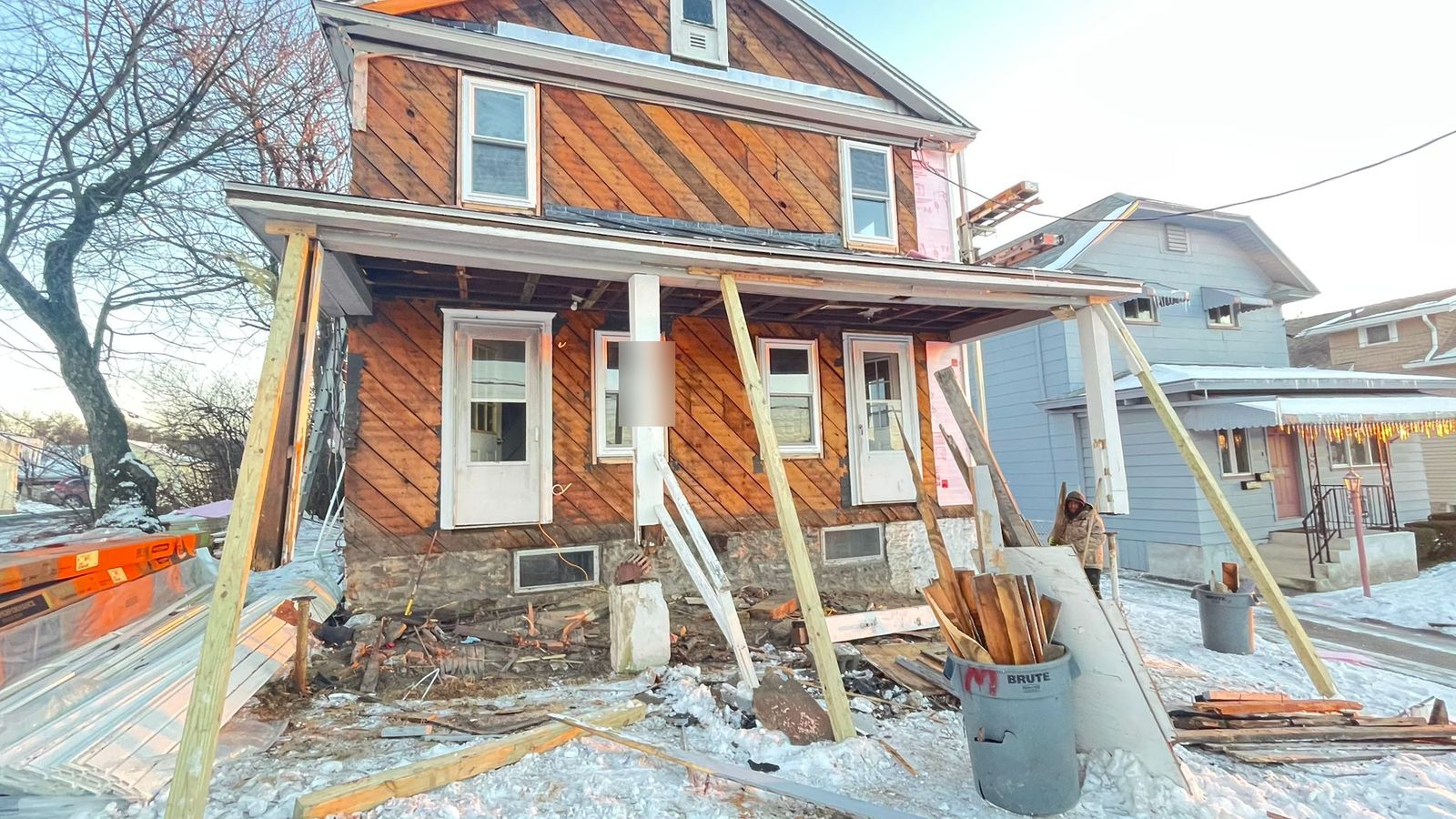
The same point shows up in our Old Forge building in Northeast Pennsylvania: purchased in 2025 for $335,000, about $95,000 invested, and appraised at $850,000 at refinance six months later. A purchase-day cap rate does not capture what the operator is about to change. Execution did that, and the lender's response to it is covered in an appraisal is an opinion, the market gives the verdict. The same sequence, applied deliberately, is what the BRRRR strategy still rewards in 2026.
It ignores timing and capital
A cap rate says nothing about how much cash the deal requires up front, how long the renovation takes, or how much reserve you need to carry it. Two buildings at the same cap rate can demand very different amounts of your capital and your attention.
How operators actually use cap rate
Operators treat it as a filter, not a decision.
- Screen. Use cap rate to quickly rank buildings in a market and throw out the ones that obviously do not fit.
- Verify the NOI. Rebuild it from the property's actual rent roll, bills, insurance quote, tax bill and maintenance history. Stress the expense lines, especially insurance and repairs.
- Run the financing. Test debt service coverage, cash-on-cash and the reserve you need. If the loan does not clear, the deal does not.
- Underwrite the plan. Decide what you will change, what it costs, how long it takes and what NOI results. Measure yield on cost, not just the cap rate you paid.
- Stress the exit. Ask what the building is worth if cap rates move against you. A deal that only works if the market gives you a lower cap rate at sale is a bet, not a plan.
I operate 125 doors in Tampa Bay, FL and Northeast Pennsylvania, and the discipline is the same on every deal: verify the income, test the debt, underwrite the plan. That is the difference between owning rentals and running them, which is the whole subject of landlord vs. operator. The cap rate is where the work starts, not where it ends.
Where buyers go wrong with cap rates
- They treat the seller's number as NOI. Rebuild it yourself from actual bills and statements.
- They compare cap rates across different markets and building classes. A cap rate only compares like with like.
- They ignore their own cost of debt. A yield below your interest cost is negative leverage.
- They chase the highest cap rate. Higher usually means more risk, not a better deal.
- They stop at the cap rate. It is the first calculation, not the last.
Frequently asked questions
What is a good cap rate for a rental property?
There is no single good cap rate. It depends on your market, the building's class and condition, the quality of the income, and your cost of debt, and it changes over time. Judge a cap rate by whether the NOI is real, whether it pays you for the risk, and whether it works with your financing. A number without a market, a property type and a date attached to it is not useful.
How do you calculate a cap rate?
Divide the property's annual net operating income by its purchase price. NOI is income minus operating expenses, before debt service, so it excludes your mortgage payment. A building priced at $1,000,000 with $70,000 of NOI has a 7.0% cap rate. Rebuild that NOI yourself from the actual rent roll, tax bill, insurance quote and repair history rather than accepting the seller's figure.
Is a higher cap rate always better?
No. A higher cap rate usually reflects higher perceived risk, such as an older building, a weaker location, deferred maintenance, or income that is harder to verify. It is better only if the NOI is real and you can manage that risk. Chasing the highest cap rate in a market is how buyers end up owning the problems other investors priced correctly.
What is the difference between cap rate and cash-on-cash return?
Cap rate ignores financing and measures NOI against the price, so it describes the building. Cash-on-cash return includes your loan and measures annual cash flow against the cash you actually invested, so it describes your position. In the illustrative model above, the cap rate is 7.0% while the cash-on-cash return is 5.0%, because the debt costs more than the simple yield suggests.
